Yongfan Liu
PhD Candidate @ University of California, Irvine

yongfal [at] uci [dot] edu
itissteff [at] gmail [dot] com
Hi, I’m glad you’re here.
I’m currently a Ph.D. candidate in Computer Engineering at the University of California, Irvine, with a research focus on computer vision and edge computing. My work spans depth estimation, streaming 3D reconstruction, vision–language models (VLMs), speculative decoding for large language models, and efficient model deployment on Qualcomm and NVIDIA platforms.
My research aims to extend advanced computer vision capabilities to AR/VR and XR devices. I am a first-author on multiple publications, including work submitted to CVPR, where I applied quantization and hardware-aware optimization techniques to achieve real-time depth estimation on mobile devices. Through these projects, I have developed strong expertise in software–hardware co-design.
My recent work focuses on 3D reconstruction for XR scenarios, particularly addressing out-of-memory challenges in long-context video processing through a graph-based memory bank design. In parallel, I am working on air quality estimation using hyperspectral imagery, leveraging vision–language models (VLM) for multi-modal environmental sensing.
Previously, I interned at NIO (an electric vehicle manufacturer) in San Jose, where I worked on speculative decoding for large language models and deployed them on automotive-grade computing platforms. This summer, I will join Samsung Research America as an intern, where I will work on research and development for the next generation of AR and intelligent devices.
I am currently seeking a full-time new-grad position at the beginning of 2027
selected publications
- arXiv
MBVGGT: Adapting VGGT for Long Video Sequences via Graph Memory Bank
In Under Review of ECCV 2026
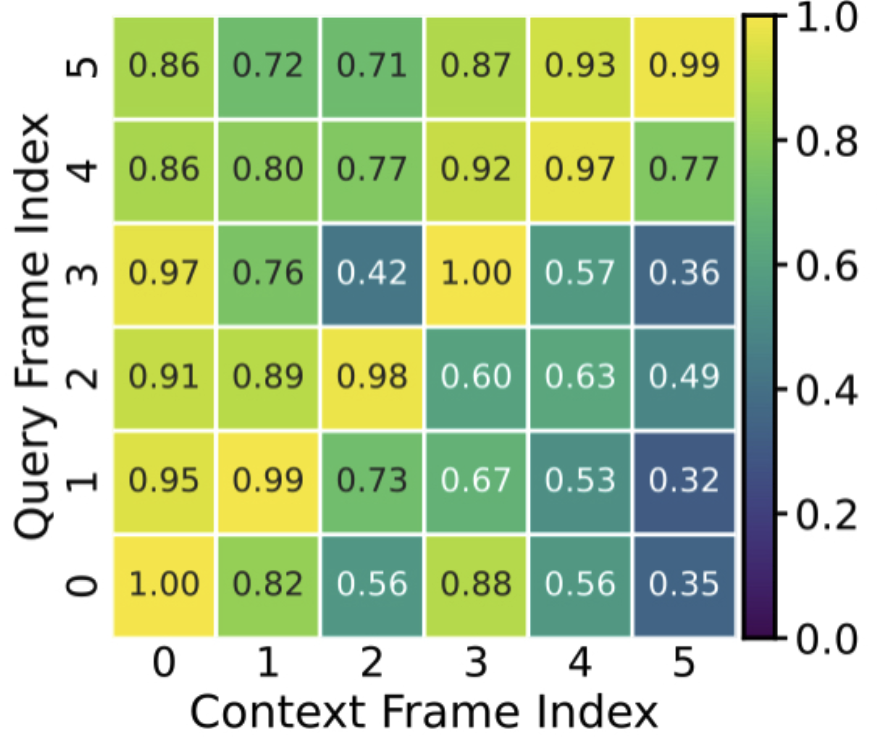
Recent advances in large-scale pretrained visual transformers have achieved remarkable success in delivering high-quality 3D reconstruction results. However, for a stream of inputs (e.g., video), they require heavy global recomputation for each new frame, which also involves quadratic memory costs to the sequence length in attention modules. To address the challenge, techniques such as caching previous keys and values have been explored. However, such approaches still incur quadratic memory costs, which hinder their deployment with long sequence inputs on memory-constrained commodity hardware. To address the challenge, we first make an observation that not all input frames are critical for processing new inputs by a quantitative analysis and utilize that observation to develop a new compute- and memory-efficient vision transformer for 3D reconstruction, MBVGGT. It employs a memory bank that maintains information of important frames only, which significantly reduces memory requirements yet enables high-quality results. Our evaluations demonstrate that MBVGGT achieves comparable accuracy across depth estimation, pose estimation, and 3D reconstruction on long content, while running 6.3x faster than the SOTA model and getting rid of the OOM error. -
Efficient Depth Estimation for Unstable Stereo Camera Systems on AR Glasses
In Proceedings of the Computer Vision and Pattern Recognition Conference 2025.
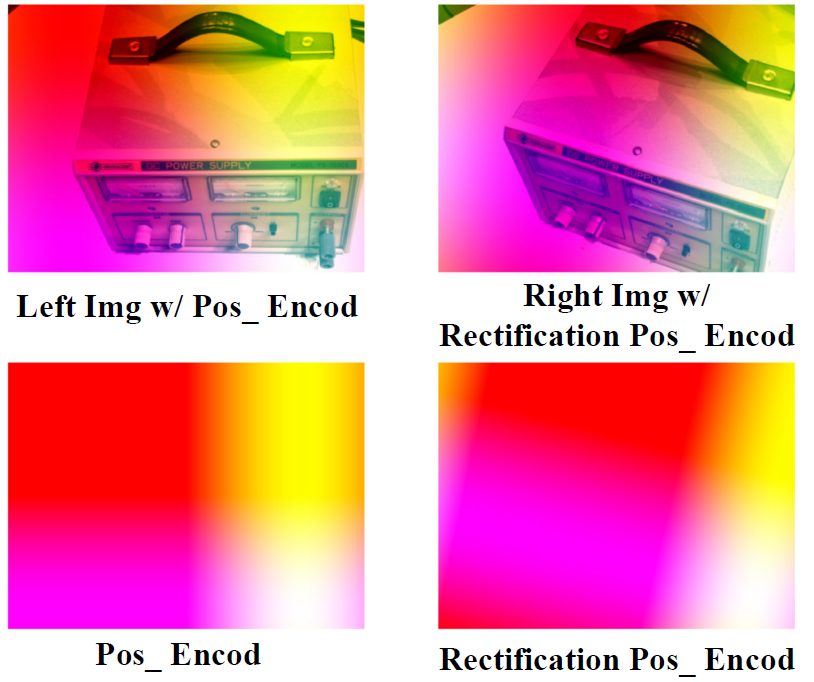
Stereo depth estimation is a fundamental component in augmented reality (AR), which requires low latency for real-time processing. However, preprocessing such as rectification and non-ML computations such as cost volume require significant amount of latency exceeding that of an ML model itself, which hinders the real-time processing required by AR. Therefore, we develop alternative approaches to the rectification and cost volume that consider ML acceleration (GPU and NPUs) in recent hardware. For pre-processing, we eliminate it by introducing homography matrix prediction network with a rectification positional encoding (RPE), which delivers both low latency and robustness to unrectified images. For cost volume, we replace it with a group-pointwise convolution-based operator and approximation of cosine similarity based on layernorm and dot product. Based on our approaches, we develop MultiHeadDepth (replacing cost volume) and HomoDepth (MultiHeadDepth + removing pre-processing) models. MultiHeadDepth provides 11.8-30.3% improvements in accuracy and 22.9-25.2% reduction in latency compared to a state-of-the-art depth estimation model for AR glasses from industry. HomoDepth, which can directly process unrectified images, reduces the end-to-end latency by 44.5%. We also introduce a multi-task learning method to handle misaligned stereo inputs on HomoDepth, which reduces the AbsRel error by 10.0-24.3%. The overall results demonstrate the efficacy of our approaches, which not only reduce the inference latency but also improve the model performance.